
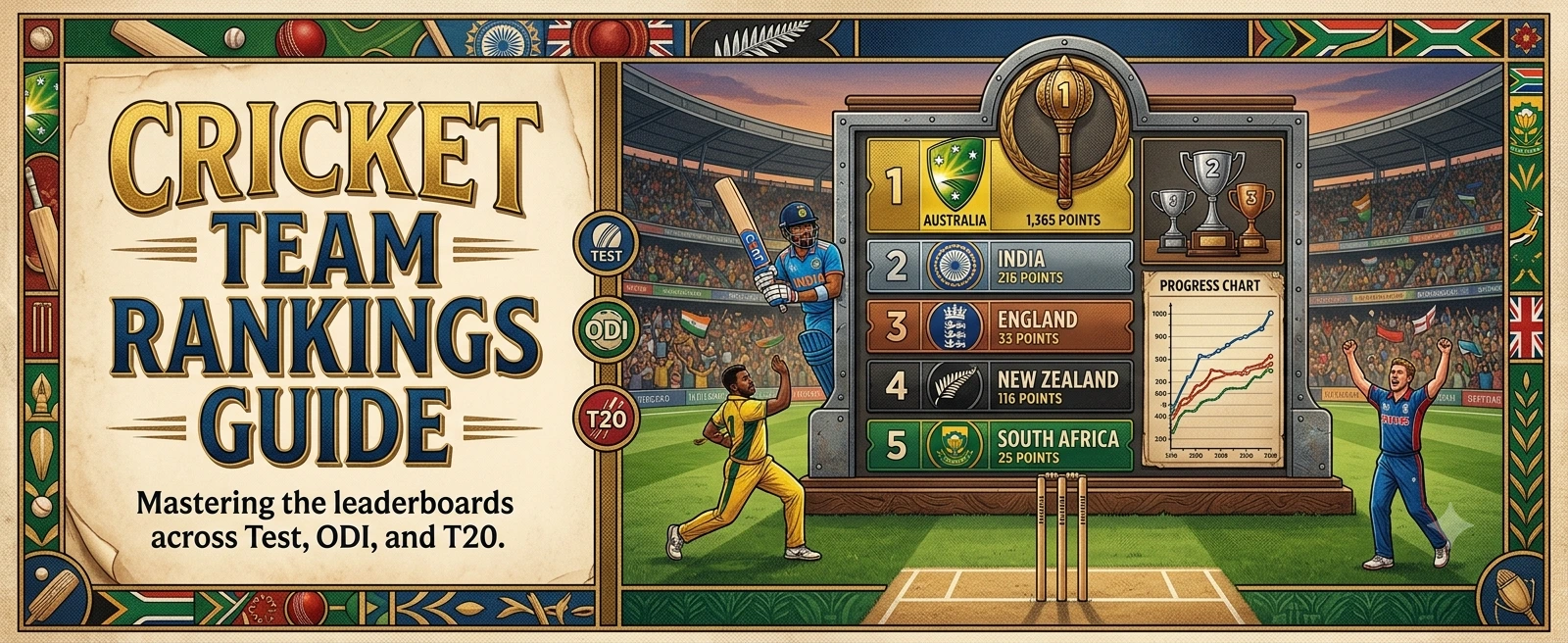
Cricket Team Rankings Guide
Introduction
Cricket team rankings provide a reliable way to compare the performance and consistency of international teams across different formats of the game. Instead of focusing on a single tournament or match result, rankings evaluate how teams perform over time against a variety of opponents. This helps cricket fans understand current team strength, recent form, and long-term progress.
Whether you follow international tournaments or regularly check Gold 365 Cricket, understanding team rankings gives valuable context before watching a match or analyzing team performance. Rankings are updated periodically based on official match results, making them one of the most trusted performance indicators in modern cricket.
If you are new to cricket analysis, this guide complements our Cricket Statistics Guide and Cricket Player Insights, where we explain how player and team performance work together to influence results.
What Are Cricket Team Rankings?
Cricket team rankings are an official rating system used to compare international cricket teams based on their overall performance. Rather than rewarding only tournament victories, the ranking system evaluates consistency over multiple series and matches.
Each format has its own independent rankings, including:
- Test Cricket
- One Day International (ODI)
- Twenty20 International (T20I)
Because every format requires different strategies, a team may rank highly in one format while performing differently in another.
For example, a nation that dominates Test cricket may not necessarily lead the T20 rankings due to differences in playing style, squad selection, and match conditions.
For the latest official ranking updates, readers can also refer to the International Cricket Council (ICC) rankings.
Why Cricket Team Rankings Matter
Team rankings provide much more than simple numbers. They help fans, analysts, and cricket followers understand how teams compare against one another over an extended period.
The ranking system helps readers:
- Measure team consistency.
- Compare performances across formats.
- Evaluate recent improvements.
- Understand international competition.
- Follow long-term progress.
When reading our Live Cricket Updates or Cricket Match Centre Guide, rankings provide additional context that helps explain why particular matches receive greater attention.
Instead of judging teams based on a single victory or defeat, rankings reward sustained performance throughout multiple series.
How the ICC Ranking System Works
The official ICC ranking system uses a rating methodology that considers several important factors.
These include:
Match Results
Winning consistently against strong opponents improves a team’s overall rating more than defeating lower-ranked teams.
Opposition Strength
Victories over highly ranked teams generally carry greater value than wins against lower-ranked opponents.
Recent Performance
More recent matches usually have a greater influence than older results, ensuring the rankings reflect current form.
Series Outcomes
Success across an entire series demonstrates consistency rather than isolated performance.
This balanced approach helps ensure that rankings represent sustained excellence rather than short-term success.
For readers interested in understanding match analysis in greater depth, our Cricket Statistics Guide explains many of the performance metrics used when evaluating teams.
Cricket Rankings Across Different Formats
International cricket is divided into three primary formats, each requiring different skills, tactics, and squad composition.
Test Cricket Rankings
Test cricket rewards patience, technical ability, endurance, and consistency over five days.
Teams ranked highly in Test cricket often demonstrate:
- disciplined bowling attacks;
- strong batting depth;
- effective captaincy;
- long-term consistency.
Test rankings usually change more gradually because fewer matches are played each year.
ODI Rankings
One Day Internationals balance aggressive scoring with strategic planning across fifty overs.
Successful ODI teams generally combine:
- reliable opening partnerships;
- adaptable middle-order batting;
- balanced bowling attacks;
- strong fielding.
ODI rankings often influence tournament seedings and international competition planning.
T20I Rankings
Twenty20 cricket emphasizes fast scoring, aggressive tactics, and rapid decision-making.
Teams with strong T20 rankings usually perform well in:
- powerplay overs;
- death-over batting;
- economical bowling;
- athletic fielding.
Readers interested in shorter-format cricket can also explore our IPL Cricket Guide, which explains how domestic T20 competitions help develop international players
Factors That Influence Team Rankings
Several elements contribute to changes in international rankings.
Consistent Winning
Teams that perform well across multiple series steadily improve their rating.
Consistency is often more valuable than isolated victories.
Strong Competition
Victories against highly ranked teams generally have a greater impact than wins against lower-ranked opponents.
This encourages competitive international scheduling
Squad Stability
Maintaining experienced players while developing emerging talent often helps teams sustain higher rankings over longer periods.
Our Cricket Player Insights article explains how individual player development contributes to overall team success.
Home and Away Performance
Strong international teams perform consistently regardless of venue.
Success in different playing conditions demonstrates adaptability, which contributes to long-term ranking stability.
Understanding Rating Points
Many fans confuse ranking positions with rating points.
The two measurements are different.
A team’s ranking position reflects its place among all international teams, while rating points measure overall performance based on recent results.
Small differences in rating points can cause teams to exchange positions after a single important series.
This is why rankings change throughout the cricket calendar rather than remaining fixed for an entire season.
Using Rankings to Better Understand Cricket
Rankings become even more valuable when combined with other performance indicators.
Before following a major international series, readers often compare:
- team rankings;
- recent form;
- head-to-head records;
- venue history;
- squad availability;
- player fitness.
Combining these factors provides a more complete understanding than rankings alone.
Our Cricket Match Centre Guide explains how these different performance indicators work together when following international matches.
Common Misconceptions About Cricket Team Rankings
Cricket rankings are often misunderstood because many fans assume they are based only on the most recent match or tournament. In reality, rankings represent a team’s overall performance across multiple series and international competitions.
Winning One Tournament Does Not Guarantee the No. 1 Ranking
A team may win a major tournament yet remain below another team in the rankings if its overall performance during previous series has been inconsistent. Rankings reward sustained excellence rather than one successful event.
Every Cricket Format Has Independent Rankings
Test, ODI, and T20 International rankings are calculated separately. A team leading the ODI rankings may hold a very different position in Test or T20 cricket.
Readers interested in understanding these format differences should also explore our Mobile Cricket Experience, which explains how fans follow every format across different devices.
Rankings Continue to Change Throughout the Year
International cricket is played almost every month. As new matches are completed, rankings are updated to reflect current performance levels, making them a dynamic indicator rather than a fixed table.
How International Teams Improve Their Rankings
Moving up the rankings requires long-term consistency rather than short bursts of success.
Winning Consecutive Series
Consistent victories against competitive opponents steadily improve rating points.
Rather than focusing on individual matches, successful teams aim to perform well across complete bilateral series and international tournaments.
Building Squad Stability
Teams that maintain experienced players while introducing promising young talent often remain competitive for longer periods.
Balanced squad development creates better adaptability across different playing conditions.
Strong Performance in Away Conditions
Winning overseas demonstrates adaptability.
Successful international teams perform well on:
- spinning pitches
- fast bowling surfaces
- high-scoring venues
- difficult weather conditions
These performances often strengthen overall rankings more than home victories alone.
Continuous Performance Analysis
Modern teams rely heavily on performance analysis.
Coaches regularly evaluate:
- batting partnerships
- bowling economy
- fielding efficiency
- match situations
- player workload
Readers can better understand these performance indicators in our Cricket Statistics Guide.
Team Rankings and Major Cricket Tournaments
Although rankings do not determine every tournament outcome, they provide valuable context before major competitions begin.
Fans frequently compare rankings before events such as:
- ICC Cricket World Cup
- ICC Champions Trophy
- ICC World Test Championship
- ICC Men’s T20 World Cup
- Asia Cup
These rankings help analysts discuss current form while understanding which teams have performed consistently over recent years.
For official tournament schedules and competition updates, readers can visit the International Cricket Council (ICC) website.
Cricket Rankings and Match Analysis
Experienced cricket followers rarely rely on rankings alone.
A complete match analysis also considers:
- current squad availability
- recent player performances
- pitch conditions
- venue statistics
- weather forecast
- historical head-to-head records
When combined with Live Cricket Updates and our Cricket Match Centre Guide, rankings become a valuable part of understanding the bigger picture rather than the only deciding factor.
The Future of Cricket Team Rankings
Technology continues to improve the way cricket performance is analysed.
Future ranking systems may incorporate more advanced statistical models, player contribution metrics, and performance analytics to provide even greater accuracy.
As cricket evolves through new tournaments, changing playing styles, and emerging talent, rankings will continue to reflect the competitive balance of international cricket.
Readers interested in player development should also explore Cricket Player Insights, where we examine how individual performances influence overall team success.
Cricket team rankings provide one of the most reliable ways to measure international performance across Test, ODI, and T20 cricket. Instead of focusing on isolated victories, they reward consistency, adaptability, and sustained excellence over time.
Whether you are following international tournaments or simply improving your cricket knowledge, understanding rankings helps you interpret team performance with greater confidence.
For a broader understanding of cricket, continue exploring our educational resources including Gold 365 Cricket, Live Cricket Updates, Cricket Statistics Guide, Cricket Match Centre Guide, IPL Cricket Guide, and Cricket Player Insights.